 |
|
This page focuses on weather science and miscellaneous fields of study. Check page one for water science topics. |
Quicklinks Water Science Weather Science Other Fields |
Comparative Temperatures |
|
Barometric Pressure
Barometric pressure is also known as air pressure or atmospheric pressure. Simply put, it represents the weight of the air above us. Just as water pressure increases as you dive deeper beneath the surface, barometric pressure drops as you rise in altitude (and thus have less air above you). Of more immediate importance, barometric pressure is a valuable indicator of weather conditions -- rapidly dropping barometric pressure typically means that stormy weather is on its way. David set out to test (and confirmed) this connection for his science project, using a barometer to measure atmospheric pressure over the course of a day that saw several air masses sweep through our area. Captain Hudson would have loved to possess a barometer in 1609; although the connection between air pressure and the weather was intuitively understood in his day, the first instrument to measure it would not be invented until 1643. |
|
Relative Humidity
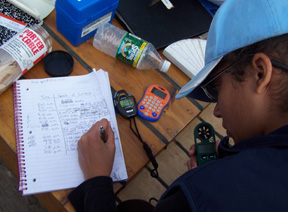
Relative humidity is a measure of the amount of water vapor suspended in the air. Sam took on this phenomenon for his project, using two separate instruments to measure humidity levels: a sling psychrometer (left) and a whirling hydrometer (right). These instruments both compare the temperature readings from a pair of bulb thermometers: one wet, and one dry. When spun through the air (either by hand with the sling psychometer, or mechanically by the whirling hydrometer), evaporation causes the two thermometers to cool at different speeds. The drier the air, the cooler the wet bulb becomes. Humidity has little effect on the Half Moon itself, but its impact on the crew can be significant. Fortunately, during this leg of the voyage, humidity levels were comfortably low. |
|
Wind Speed
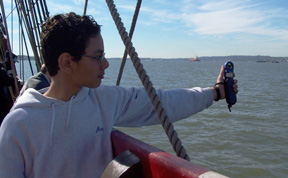
The Half Moon is a sailing vessel, of course, so few atmospheric conditions have a more direct effect on us than the wind's speed and direction. In 1609, Hudson's progress was often at the mercy of favorable winds. Our students use hand-held anemometers to accurately measure the wind's speed. As the wind blows through and spins an anemometer's fan, the electronic instrument records the wind's highest and average speeds. |
|
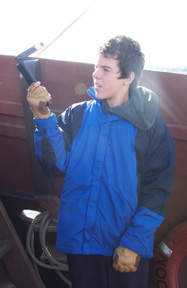
On this voyage, Amro used such an intrument to compare wind speeds at different altitudes. To the above left, Amro takes a reading from the weather deck. At the same time, his recruited research assistants (here including Mr. Beiter, Mr. Colley, and Nick) measure the wind speed from the main mast top. Amro's research found that wind speeds were generally higher at higher altitudes. This would have come as no surprise to a shipwright in Hudson's day; top sails are designed specifically to grab these higher, stronger winds. |
|
Solar Energy
Solar energy forms the heart of every river ecology; sunlight fosters algae and plant growth, which in turn forms the bottom rung of the ecology's food chain. For his aspect of the Starboard Watch presentation, Nate mounted a photovoltaic cell atop the capstan (right), then took regular readings of the cell's electric output over the course of a day. Meanwhile, he also used a quadrant (left) to mark the angle of the sun in the sky, and correlated the sun's position with its energy output. Purely out of scientific curiosity, he also used these instruments to test the electrical output of the full moon over the course of a night -- in this case, despite the clear skies, the moonlight was unable to produce measurable results. Of course, Captain Hudson and his crew in 1609 had no photovoltaic cells on their ship, but they did make use of solar energy in their own way. For example, one of their staple foods was dried cod, and establishing trade for beaver pelts saved the voyage (economically speaking). Both the fish and the pelts were prepared in the same way: by stretching them out on wooden frames to be dried by the sun.
|
|
Mechanical Advantage
Mechanical advantage is the ratio of output force divided by input force in a simple machine, such as a pulley, lever, or winch. The greater a machine's mechanical advantage, the greater its output force compared to its input force. In other words, simple machines with positive mechanical advantage make it easier to lift or move heavy objects. We use simple machines all over the Half Moon in a wide variety of forms and uses. For example, our capstan (left) is a massive winch used for tasks such as weighing anchor. The anchor alone weighs over 400 lbs., while the total load on the capstan (including the anchor, chain, line, and the strain of pulling the ship against the current) while weighing (rasing) anchor can approach a ton. Despite this, with the capstan's help, just eight students can raise our anchor without a problem (though certainly not without effort!).
The differently colored boards around the foot of the capstan visible above are due to general repairs and maintenance Mr. Colley performed on the capstan during our stay in Albany, which required pulling up and replacing some of the weather deck's planking. Our new-and-improved capstan produces much less friction than it did before, making its use considerably smoother (and thus easier). |
|
|
Click here to see a brief video of the capstan in action as we raise the main topmast. (Requires Quicktime). The loud creaking noise is the sound of the top mast groaning as its weight slides down the main mast. In the helm hutch, we use a whipstaff to steer the ship (left); the original Half Moon predates wide use of the ship's wheel by about a century. The whipstaff is a simple lever, allowing a single crewmember to easily push the ship's massive rudder and tiller to back and forth. Above the ship, we use dozens of blocks (pulleys) in the rigging to handle the sails. The lateen sail alone, our simplest sail, uses more than twenty! |
|
Wildlife
Although none of our students are specifically studying the river ecology on this leg of the voyage, the Half Moon still provides us with an excellent vantage point to examine the flora and fauna of the Hudson River Valley. We've noticed changes in the local bird populations since our first leg in September, no doubt due to the birds' migratory patterns. Although great blue herons and cormorants are scarce, we've still spotted a few bald eagles perched high in their aeries, as with this lofty fellow to the left. During our research layover, we'll also took the students out on Zodiac expeditions to exlore the nearby Brooklyn waterfront and search for more specimens to study. The samples our crew brought back from these excursions included both flora and fauna, including a mussel in its shell (bottom center) and what our students determined to be a butternut (bottom right). Particularly interesting specimens were dissected and/or examined under the microscope. The gull below was simply a spectator; it floated past us while following a dead fish the current carried on by our position.
|
|
As a note, what you see in the photo to the left is not in fact a crab; it's just a carapace -- a hollow crab shell. At some point, the crab grew too large for this carapace and molted, opening up its back like an escape hatch (you can see the gap) and slipping out. This carapace's former owner may well still scrabbling around out there, somewhere in the waters off Brooklyn. |
|